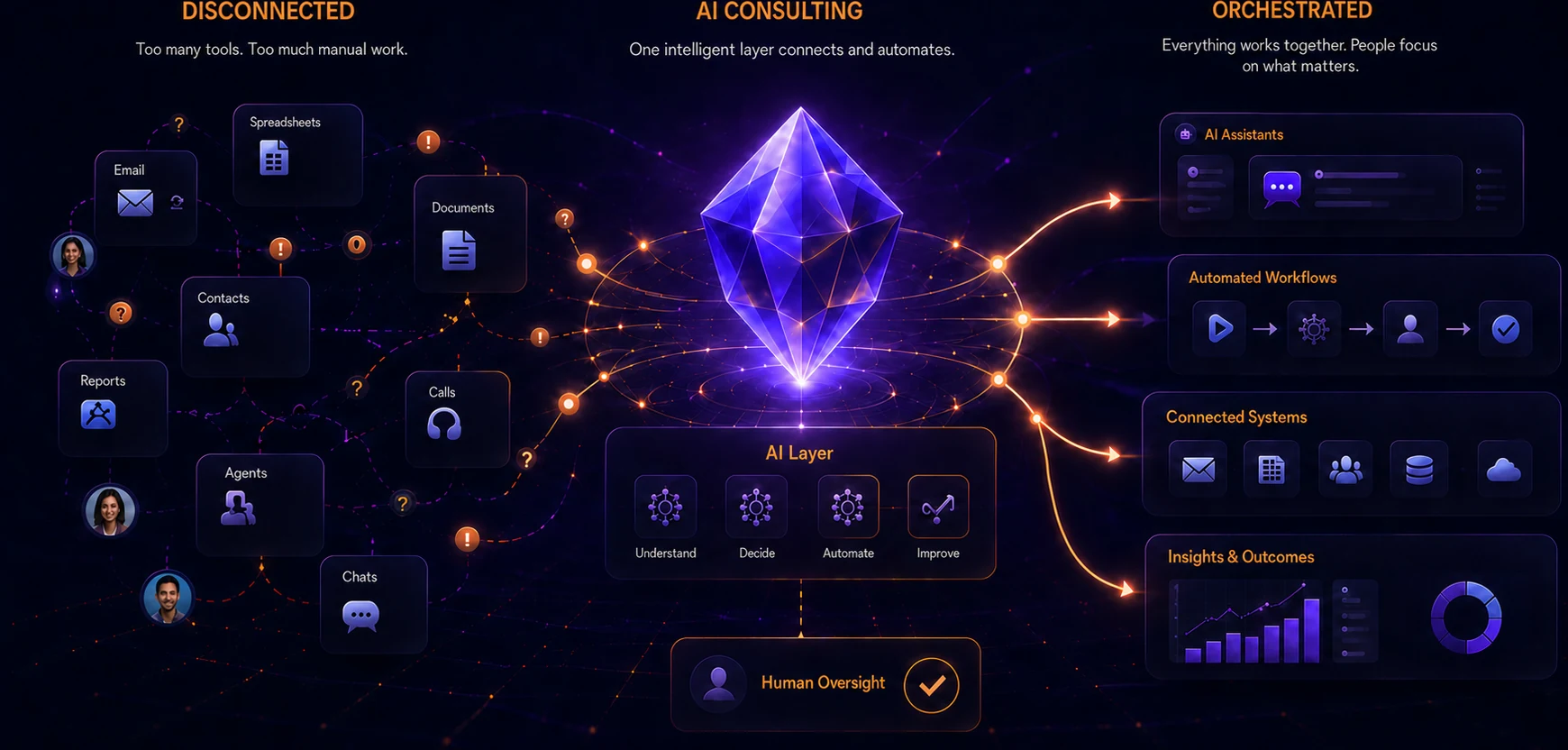
Identify where AI can create value, decide what to do first,
and move from a practical roadmap to implementation,
automation and team adoption.
AI can improve marketing, sales, customer service and everyday operations. The challenge is knowing where it will create real value, which tools fit your business and what to implement first. Our AI consulting helps small and medium-sized businesses make those decisions and turn them into a practical plan.
You use several programs and constantly jump between them to complete a single task. Nothing is connected, there is no consistent workflow, and you are obviously losing time due to an inefficient way of working.
You tried AI for tasks such as article writing or Instagram posts, but the results required so much editing that you spent more time than you saved. It felt easier to do the work yourself, so the experiment stopped there.
You know where time is being wasted, where customers are waiting and where work keeps getting stuck. What is less clear is which of these problems AI can solve, where it could reduce costs and where it could support growth.
Even if you decide to introduce AI, you may not have anyone with enough knowledge to select the right programs, coordinate the work and take responsibility for implementation. Without a clear owner, the project can stall before it begins.
Answer ten plain-language questions and get an immediate, honest assessment: where you stand, which foundations are missing, and the one thing to do first. Free, three minutes, no registration.
Take the readiness checkRuns in your browser · nothing is transmitted · the same logic the consulting uses
Two people can use AI every day and get completely different value out of it. The difference is not talent, it is the stage you work at. Read down the ladder until you recognise yourself. Every engagement I run starts with exactly this question, and each stage below links the step that takes you one level up.

You ask AI questions the way you used to ask Google, and you get faster answers. A quick explanation here, an email draft there, and the tab closes again. Useful minutes, nothing that carries over to tomorrow.
Next step: see what AI can actually carry, in half a day
You have noticed that how you ask decides what you get back. You give context, set constraints, show an example of what good looks like, and you keep the prompts that work so you never start from zero twice.
Next step: make this your team’s normal, not your party trick
AI sits inside your working day, not next to it. You pick the right model for the job, you set up projects and instructions once and reuse them everywhere, and your results arrive faster than your colleagues expect.
Next step: let the repetitive work run without you
You chain tools together and the first automations fire on a schedule instead of waiting for you. Research lands summarised, meeting notes write themselves, and part of your work now happens while you are somewhere else.
Next step: build one solution that earns its keep
You stop doing the tedious task and create the thing that handles it. Small internal tools and assistants, each scoped to one job, each running end to end, and each one freeing hours you used to lose.
Next step: put an assistant in front of the repetitive questions
You design systems instead of doing tasks. Agents hand work to each other, whole processes run under your supervision, and your job has quietly changed from producing the output to reviewing it.
Next step: a roadmap that decides what to systemise next
Your business runs on an AI workforce around the clock, and you spend your time only on the things only you can do. Nobody fully lives here yet. You are building toward it anyway, and so am I.
Next step: tell me how it is going. Seriously.Most companies I meet are at stage one or two, with one enthusiast at three. That is normal, and it is exactly the gap this work closes: the audit finds your stage, the roadmap picks the next one worth reaching, and implementation, automation and training move you there. You do not need stage seven. You need the stage where your numbers change.
We begin with a focused AI audit, identify where AI can create value and turn the findings into a practical implementation plan.
We examine the tasks, delays, bottlenecks and missed opportunities affecting your day-to-day work. This shows which problems are worth solving and where improvements would have the greatest business impact.
We turn suitable problems into specific ways to use AI. You see which processes could be automated, which areas could work more efficiently and which ideas are unlikely to deliver enough value.
We compare each potential solution by business value, cost, implementation effort and risk. You receive a clear priority and know which project offers the strongest and most realistic first result.
We define how the selected solution should work, which programs are required, who will be responsible, how success will be measured and what happens next. You receive a prioritised roadmap and a detailed brief for moving directly into implementation.
You receive six practical deliverables showing where AI can help, what to implement first and how to move forward. Everything is documented and ready for your team to use.
This service is designed for small and medium-sized businesses that need a practical way to decide where AI can help, what to implement first and how to move forward.
I bring 17+ years of hands-on experience across online marketing, e-commerce, team leadership, and practical AI. In that time I have done all of it hands-on: SEO, SEA, content marketing, and online shops from planning through implementation and management. Ever since artificial intelligence entered the scene, I have been working out the best ways to implement it within online marketing and e-commerce.
A prioritised list nobody builds is an expensive document. These are where the first item usually goes, and you are free to take it elsewhere.
You know something should be built and cannot yet say what. After this, one working AI solution is live in weeks, moving a number you chose before it was built.
See the service › Repetitive tasksYour team spends hours a week moving information between tools by hand. After this, that process runs itself in your own environment, documented and owned by your team.
See the service › Repetitive questionsThe same questions eat your support and your staff's day, again and again. After this, an assistant answers them from your own content, and hands over cleanly to a human when it matters.
See the service ›If the question is specifically marketing and e-commerce, the AI Marketing Audit is the same method at narrower scope: fixed price, about three weeks, its own roadmap. Cheaper and sharper when you already know where the question lives.
If your people need to be able to use what gets built, that is Workshops & Training. Adoption decides whether any of it survives the first quarter.
The method does not change. What changes is which data you are allowed to touch, and where the fastest win actually sits.
Patient data never leaves the building. Documentation that runs past the last patient, fee justifications, and recall.
See the page ›Client files never leave the building. Deadline seasons, chasing documents, and knowledge locked in individual heads.
See the page ›The mandate stays confidential. Research that eats the margin, answered with sources you can trace rather than trust.
See the page ›A listing brings a hundred enquiries. The first agent to answer usually wins, and that is a speed problem before it is a data one.
See the page ›Same method, different scope. The audit looks at marketing and e-commerce; this looks across the company, including operations, service and internal work. A clearly marketing-shaped question wants the audit.
No. The roadmap is written to be acted on by your team, another supplier, or nobody. Not a sales document with the answer withheld. Implementation is available, never a condition.
A few weeks, not months, scope agreed before the start. Mostly interviews, watching how work moves, then the ranking. You are not occupied full time.
Whoever knows how the work really happens, which is rarely the org chart. A handful of short conversations across the teams, plus one person with the authority to act on the result.
Then you will be told that, and where the money would do more good. A roadmap recommending stopping two things and starting one is a legitimate outcome, and cheaper.
Yes, including the embarrassing parts. The work depends on seeing how things actually run, which only happens when people can be honest without consequences.
Request a call. Bring what has been tried, what is being considered, and the part nobody agrees on. You get a straight read on whether an engagement is worth it, including when it is not.
Request a callVendor-neutral · nothing resold · you own the roadmap